

Light Bulbs
The 1000Bulbs.com Difference
- The quality you need. We carry lighting products by Sylvania, GE Lighting, Philips Lighting, and many more trusted manufacturers.
- The affordable prices you want. Our extremely low prices reflect our number one goal: Making quality lighting affordable to everyone!
- A huge selection and helpful application information. We have thousands of lights and lighting accessories to fit your specific needs.
- Lighting that saves you money. Our energy-saving compact fluorescents and LED bulbs can drastically reduce your energy costs and help protect the environment.
LED Light Bulbs
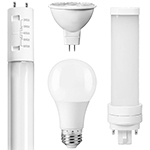
LED light bulbs are up to 80 percent more efficient than traditional lighting. These bulbs can be found in a variety of shapes including BRs, MRs, and LED tubes. Some LED lighting may qualify for rebates on top of the exceptional energy savings. Look for bulbs that are Energy Star, Title 24, and JA8 rated.
Fluorescent Light Bulbs
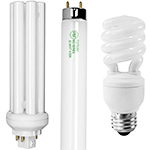
Fluorescent light bulbs come in a variety of types, shapes, and sizes. To produce light, these lamps use a phosphor coating to convert UV light into visible light. Depending on the makeup of the phosphor coating, linear fluorescents can provide a higher color rendering index (CRI) to help color appear more natural. The 800 series have CRIs in the 80s while the 900 series have a high CRI of 90 or higher. Fluorescent lamps are suitable for use in office buildings, warehouses, workshops, and big-box retail stores.
Incandescent Bulbs
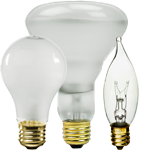
Incandescent light bulbs are used in a wide number of applications in and around the home. The most familiar incandescent is the A-shape (A19) with a medium screw-in base that is common in general household lighting such as table lamps. Incandescents use a lot of energy to generate light, however much of that energy is lost as heat.
As of August 1, 2023, most common household incandescent and halogen bulbs have been banned. Some bulbs are still allowed. Bulbs that can still be sold include appliance lamps, bug lights, black lights, antique reproduction lamps, colored lamps, plant lights, and traffic signal bulbs.
Halogen Lights
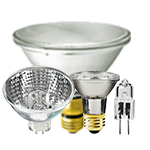
Halogen light bulbs contain a small capsule filled with Halogen gas, which emits a bright white light. Using the same amount of power as incandescents, these lights last longer and produce a better quality light. Halogen bulbs are sensitive to the oils on your skin. These oils can cause hot spots on the lens which cause the glass to break when heated so it is recommended that you wear gloves when handling them.
High Intensity Discharge Lights (HID Lamps)
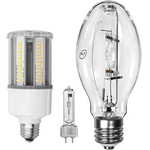
High intensity discharge lights (HID) include metal halide, high pressure sodium (HPS), and mercury vapor lights. These lamps use an electric arc to produce light. The electric arc flows between two electrodes inside a quartz arc tube that is filled with gas and metal salts. This method of illumination produces more visible light, letting HID lamps emit more light than incandescent or fluorescent lamps. Like fluorescent bulbs, HID lamps require a ballast to operate. HID lamps are commonly used in parking lots, streets, and warehouse lighting.
Black Lights
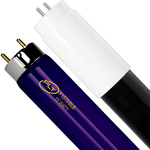
Black lights are bulbs that emit ultra-violet (UV-A) light and very little visible light. They are available in two types: "blacklight blue" and "backlight". Blacklight blue (BLB) lights are the most common. They have a distinct blue coating due to the blue filter use to block the visible light. Blacklight (BL) lamps don't have a filter and look like a regular fluorescent tube. Black lights can be used for parties and events, and are also used to detect invisible ink, authenticate oil paintings, and find counterfeit currency.
Antique and Vintage Bulbs
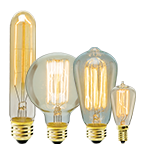
Antique and vintage light bulbs are reproductions of turn-of-the-century lighting. Recognizable by their unique filaments, these bulbs deliver a warm glow and are a popular choice for DIY and restoration projects. Due to the low Lumen output, antique bulbs are for decorative use only.
Colored Light Bulbs
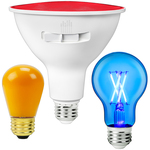
Colored light bulbs are bulbs with colored globes. Often referred to as party lights, these light bulbs come in a wide range of bulb shapes and a variety of colors including red, pink, blue, green, and orange. Use them for parties, weddings, sporting events, holidays, and much more.
Stage and Studio
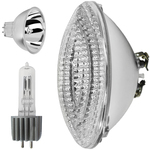
Stage and studio lamps cover a wide range of specialty bulbs designed for photography, theatrical and stage lighting, and other similar applications. From sockets to HPL lamps, we have exactly what you need. Easily search using your bulbs ANSI code, or browse by bulb shape.
UV Germicidal
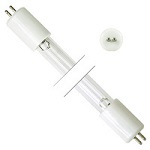
UV germicidal lamps are specialty lamps used to disinfect food, water, and air. The short ultraviolet wavelengths produced by these lamps help eradicate harmful bacteria, viruses, and other pathogens. Please note that these lamps are intended for used in existing ultraviolet or germicidal systems only, and are not meant to be used for illumination purposes.
Do you need help finding the best light bulbs for your application? Shop by application to see additional categories or speak with a member of our helpful staff today by calling 1-800-624-4488!